

| High-temperature seals | ||
Mechanical seals designed for working temperatures above 220 °C up to around 400 °C. In this temperature range secondary seals made of elastomers or PTFE are no longer stable. With the materials for secondary seals suitable for use at these temperatures (e.g. pure graphite) being sensitive to dynamic loading, the choice falls almost exclusively on metal bellows mechanical seals with secondary seals under purely static loading. The bellows is mostly constructed as a laminate bellows or more rarely as a rolled bellows. In the high temperature range the process media are usuallly sensitive to oxidation (cf. heat transfer oil) or can be pumped only at these temperatures on account of their high solidifying points. |
The medium must be prevented, therefore, from coming into contact with atmospheric oxygen. Setting on and inside the mechanical seal would destroy at least the seal's function if not the seal itself. For this reason, high-temperature mechanical seals are generally designed as double mechanical seals or as single mechanical seals with quench. As a rule the quench is sealed by a second mechanical seal which is installed in tandem arrangement downstream of the primary mechanical seal. |
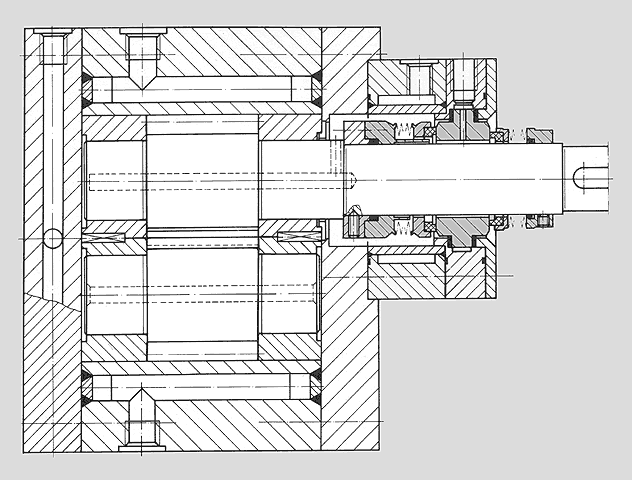
Heated gear pump featuring two laminate bellows mechanical seals in face-to-face arrangement for highly viscous media with high solidifying points
 |